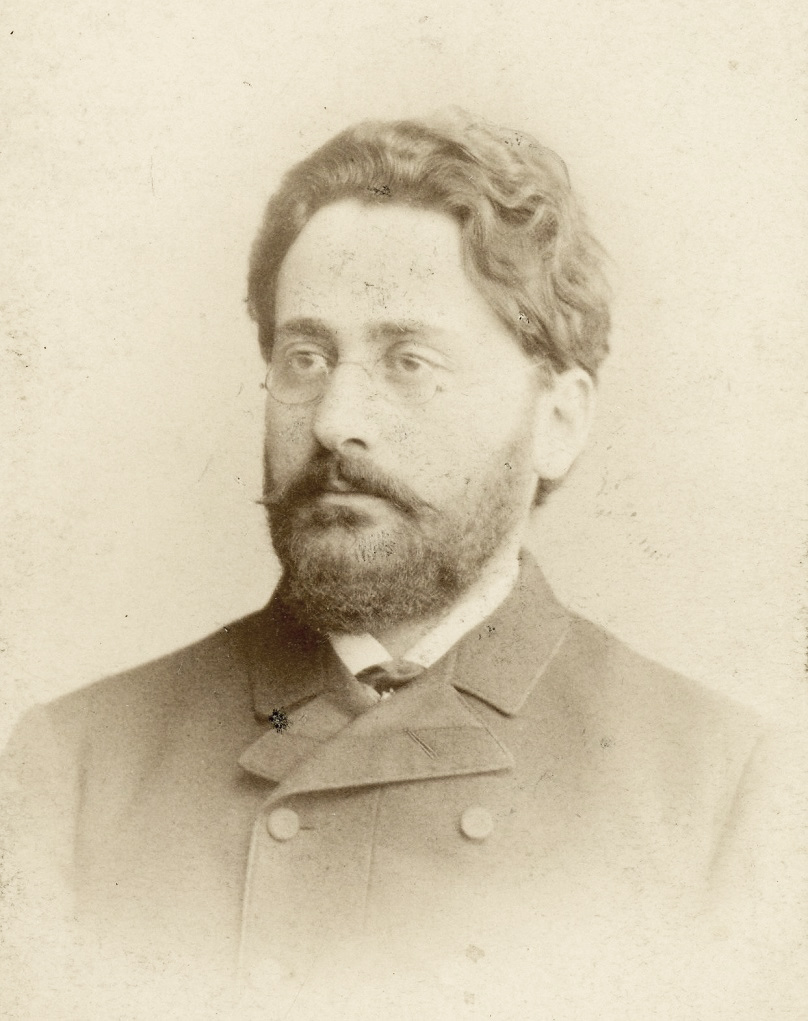
The two cartes-de-visite on this page came from an antiques dealer in Greenfield, Massachusetts, in the northwest part of the state. On the back of the carte above is the name Adolphe with a question mark:

The portrait was made at the studio of E.v. Eggert, which probably stood for Emmanuel von Eggert (see visitor comments below). One Latvian website uses the name Emanuels Egerts.

The carte below was made at the same studio, at the same address, but it has a different design on the back. The sitter is an older man and the card itself looks considerably older. On the back is the name “Abraham Z.”


Abraham may have been Adolphe’s father or uncle. The names are written in different hands, and the question mark after Adolphe’s name suggests he was a distant relative of the writer, rather than a direct ancestor.


Sadly this is what happens when you have wonderful family photos where no one has been identified. It would be interesting to know how these two ended up in Massachusetts!
LikeLiked by 2 people
So true! Most Latvian immigrants to the USA came in the 20th century, decades after these photos were taken. A few came at the end of the 19th century. Massachusetts has the fifth-largest number of residents of Latvian descent, after California, New York, Illinois and Florida (2000 Census). I’d love to know something about Abraham and Adolphe.
LikeLiked by 2 people
Me too. 🙂
LikeLiked by 1 person
I hope they survived to die a natural death old age rather than what happened to so many Latvian Jews in those days. Nice portraits.
LikeLike
Thank you, Val. The earliest Latvian immigrants to the USA were leaving Russia to avoid serving in the Tsar’s army. Finns and others did the same. Let’s hope they came over then!
LikeLiked by 1 person
Not only the tzar’s army. Had it not been for things like pogroms, Lithuania or russia may have known a composer and performer by the name of Yuri or Georg Gershowitz.
Instead the U.S. boasts George Gershwin.
LikeLiked by 1 person
Interesting pictures! As others have already commented, it would be interesting to know what became of those men and their families. The fact that the name and address of the studio are given in German are a reminder that in the 19th century a good part of the population of Riga was German. The name, by the way, was most likely Emmanuel von Eggert (the addition of s’s at the end is a ‘Latvinisation’ of the German name, and the ‘v’ is lower case, indicating ‘von’). This also makes me wonder whether the sitters considered themselves to be German rather than Latvian, since they used the services of a German photographer. My own German family has roots in that part of the world, in particular Klaipeda, now in Lithuania, but then in East Prussia and thus part of Germany.
LikeLiked by 1 person
Nice to hear from you, Little Sparrow! I’m sure you’re right, of course, about the name Emmanuel von Eggert. I was highly skeptical about the spelling on the Latvian museum site. I studied Russian history in college, but never studied the Baltic countries or Prussia. In collecting, I’m drawn to photos from Tsarist Russia for their historical elements, whereas I tend to choose photos from the UK, Germany and Scandinavia more for their aesthetic appeal.
LikeLiked by 1 person
Well, being German I was of course drawn to the German element.
I’ve been on holiday, btw., and while I haven’t been cut off from the internet, I decided to take a holiday from WordPress as well. That’s why I’m now reading posts from two weeks ago.
LikeLiked by 1 person
A holiday is a good thing. 🙂
LikeLike
Germans had been the ruling nobility in the Baltics since the 13th century. The Undeutsche were just the lower class of the society – servants and workers. The situation that erupted violently in 1905.
The Baltic governorates had specific regulations allowing the German language and culture to persist even under the russian empire, the townfolk were mostly the “better people”, die Deutsche – at least speaking German, whatever their actual ethnic roots. They may have been composing any substantial percentage of the population, but they were the ruling class.
The Latvian language simply has the tradition of adapting names to its grammatical system, making them available for declension, through adding endings, with -s being the most widespread for masculine.
Not sure whether in 19th century (and early 20th) there were numerous Latvian photographers to go to, so choosing to use services of a German one hardly expressed any ethnic affiliation. But from the little I know the Germans and the Jews considered themselves closer in comparison to their relations with the locals (or the russians). The “Kristallnacht”was yet not in sight…
LikeLiked by 1 person
Thank you for the very interesting comments and observations, Aldis! You can see three additional posts with photos from Latvia if you click on the “Latvia” tag. I’d be curious to hear your thoughts about one of them, titled “Light in the darkness (WWI).” Cheers from Vermont, Brad
LikeLike
BTW.
The site of the Academic Library you pointed at features a number of images by Emmanuel von Eggert. And those are portraits of some outstanding Latvian culture personalities.
Eggert also had a workshop in Jūrmala. As his card back states: “Praemirt Florenz 1887…”, so he was a well-known and skilled photographer. Well, at least an owner of an atelier…
LikeLiked by 1 person