School group in the North after the Civil War
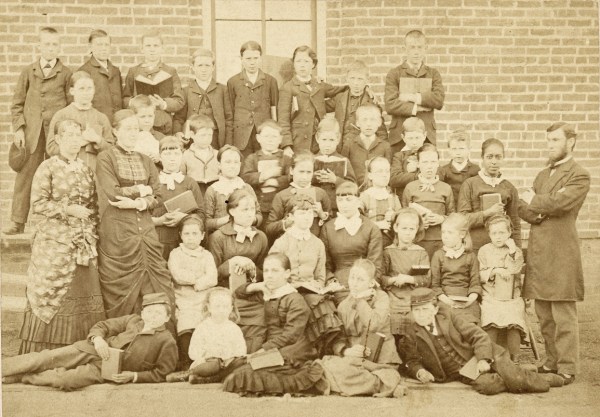
This early cabinet card has no information on it, but we can make a few reasonable assumptions.  The cabinet card format was introduced in London in 1863 and in the United States in 1866.  The two boys lying on the ground are wearing dark blue hats of the type worn by Union soldiers during the... Continue Reading →

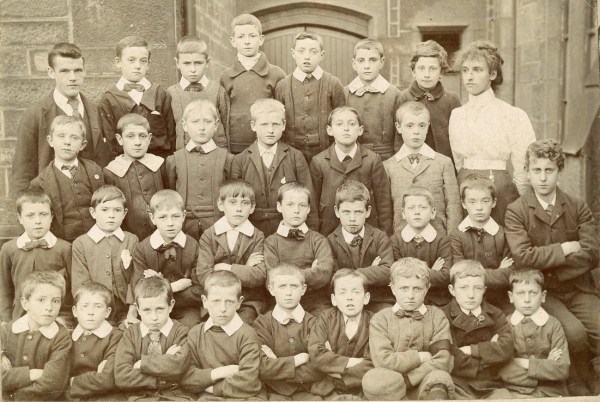
Schoolboys in Scotland take the new century seriously (1900)

The first thing I noticed about this class photo was how stern all the boys look.  That isn't exactly normal for a group of 29 little boys.  Then I realized that no one is blinking or fidgeting, which is pretty amazing.  Whatever the photographer said to them, it definitely got their attention. Another striking thing about... Continue Reading →

Dublin girls will break your heart

I completely made up the title of this post, so it probably isn't true at all, but it sounds like something you'd hear in an Irish ballad. This cabinet card portrait was made at the Lafayette studio in Dublin, founded by James Lafayette and his three brothers in 1880.  Advertising on the back lists medals... Continue Reading →

Young men in Vermont in the final December of the Civil War (1864)

One hundred and fifty-four years ago this week, seven friends sat for a portrait at Nathaniel L. Merrill's Photographic Gallery in Springfield, Vermont. They look young enough to be in high school, or perhaps recent graduates.  The carte-de-visite photo has a revenue stamp on the back, affixed and cancelled by the photographer on December 22,... Continue Reading →

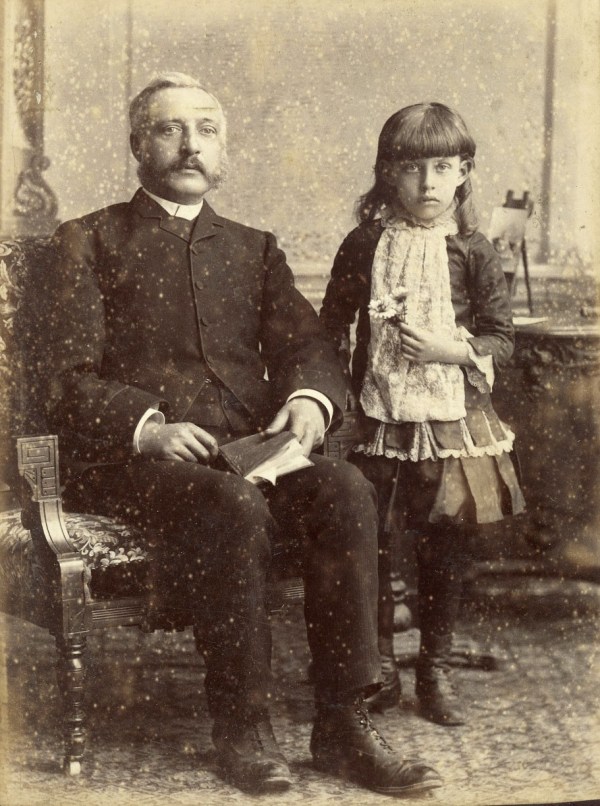
Father and daughter in Hamilton, Ontario

The back of this cabinet card is blank, so I can't say for sure that the sitters are father and daughter, but it's a safe bet.  At first I thought he might be wearing a clerical collar, but they always clasp in the back, rather than the front. His suit is simple but well-tailored.  Her... Continue Reading →

The artist in the mirror (Adolphe Braun)

This carte-de-visite is part of a series called "Costumes de Suisse," published around 1869 by French photographer Adolphe Braun (1812-1877).  Braun's studio was in Alsace, France, in the village of Dornach, near the borders with Germany and Switzerland.  Each photo in the series presents a young woman in a traditional costume from a particular Swiss... Continue Reading →

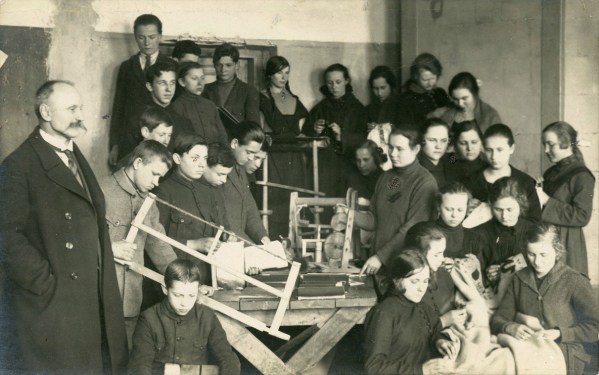
Learning to build a nation: students in the new Latvia

On November 18, 1918, Latvia declared independence from the new Soviet government in Russia.  In November of this year, Latvians celebrated the centennial of that event.  Neighboring Lithuania and Estonia will be celebrating the centennial of their own independence in February 2019.  Finland's centennial celebration took place on December 6, 2017. The photo above was... Continue Reading →

Millie at the Juneau Restaurant in Milwaukee (1911)

When I bought this postcard, I assumed the Juneau Restaurant was in Juneau, Alaska.  Naturally, I was wrong.  The restaurant was attached to the Hotel Juneau in Milwaukee, Wisconsin.  The hotel was named for city founder Solomon Juneau, a French-Canadian fortune-seeker who arrived in the area in 1818.  (The state capital of Alaska is named... Continue Reading →

Two friends in Tsingtao (Qingdao), China

This portrait was probably taken in the 1920s (see comment by my dream walden below).  The sitters aren't identified.  They're dressed identically, but I don't know if their clothing can tell us anything about them. A stamp on the mat below the photo tells us the studio belonged to a photographer named Hanson: The mat... Continue Reading →

Members of the Friends War Victims Relief Committee in Metz, France

Update, November 8, 2018: Thanks to the research efforts of my brilliant readers, I'm able to update this post with information about the group above.  The following quotes in italics are from a web page, Friends War Victims Relief Committee in the Franco-Prussian War, on the site quakersintheworld.org: The first official Friends War Victims Relief... Continue Reading →

Fair fortune-tellers in a dark Danish wood

If you encountered three enchanting ladies in a wood at dusk, and they offered to tell your fortune, would you accept? In the land of Hans Christian Andersen, anything is possible....   I have yet to find any information about the photographer, P. Christensen.  Sonderburg is the German name for the town of Sønderborg, in... Continue Reading →

Ensemble with mandolins, lute and lyre-guitar

This cabinet card was listed for sale in England without any information, and only after receiving it did I see "F DOWNER WATFORD" in the lower right corner of the image.  Frederick Downer (1840-1919) was the first commercial photographer in Watford, which is 15 miles (24 km) northwest of central London. Mandolin ensembles and orchestras arose... Continue Reading →

Blog at WordPress.com.

Up ↑